
SCIENCE: Handling your "What If"s with clarity
How Expected Utility Theory can tame the uncertainty
Burnt Out? Stuck? You're Not Broken
–
Find Your Discernment
–
Click Here To Work With Me
–
Burnt Out? Stuck? You're Not Broken – Find Your Discernment – Click Here To Work With Me –
Before we get started, a warning: If you’ve ever told yourself “I’m terrible at math,” then this post might be one big trigger for any childhood trauma still hanging around the edges of your brain.
Stick with me, though, because I promise it’s worth the mental lift. At the end of today’s post, you’ll have a framework for making the most uncertain of life’s decisions. And then next week, we’ll put that framework into practice with one of the thorniest of life’s decisions: filing for divorce.
(And also, side note, you are good at math. The problem isn’t you…it’s that you weren’t taught math well).
PS. You don’t have to navigate this alone. Click the button to book a free 15-minute call ↓
Remember Aya from last week? Let me (re-)set the scene.
Aya had been married to Priya for a decade and a half.
Unfortunately, like so many marriages, theirs had gotten mired in the mangroves of hurt feelings, mislaid expectations, and the unfortunate friction of familiarity. “We don’t even really like each other any more,” Aya told me. “We just coexist, and not even very well.”
To make matters more complicated, Aya had met—and fallen for—Daniel, which had thrown her into even more confusion. “You don’t go into a marriage thinking you’re going to get divorced,” she said, “but here I am, a total cliché. I don’t like my wife. She doesn’t like me. And I’m in love with someone else.”
Taking the next step, though…it paralyzed her. How was she supposed to make that absolutely massive, crushingly consequential “Should I stay or should I go” decision?
The problem with a decision this big is it carries with it a whole bunch of what ifs. For Aya, those were:
What if I leave, and it doesn’t work out with Daniel?
What if I stay, and things with Priya just get worse and worse?
What if I leave but things would have gotten better with Priya, had I just put more effort into it?
And so on…Aya had expended so much emotional energy, so much mental space (and so much time and money on therapists’ couches), and all she had to show for it was an eloquent way to talk about her what ifs.
She was no closer to a decision. Not for lack of trying, either. What Aya was missing wasn’t effort; she’d put in a lot of that. It also wasn’t a way to explain the decision and its uncertainty. She could do that too.
What she was missing was a framework, A How for her consequential decision
And that’s what we’ll build today.
Expected Utility Theory
In 1944, John von Neumann and Oskar Morgenstern published their Theory of Games and Economic Behavior. In it, they created a framework for making “rational” (their word) decisions under uncertainty. They called it expected utility theory.
And yes, expected utility theory sounds like it belongs in a graduate seminar, not a Tuesday afternoon blog post, but the core idea is pretty simple. It fits in three steps.
STEP 1: Utility
Let’s start by talking about the second word, utility. (We’ll do expected next, then we’ll put them both together).
What did von Neumann and Morgenstern mean by the word utility? What they didn’t mean is how we usually use the word. Utility does not mean usefulness.
Instead, think about utility as happiness points.
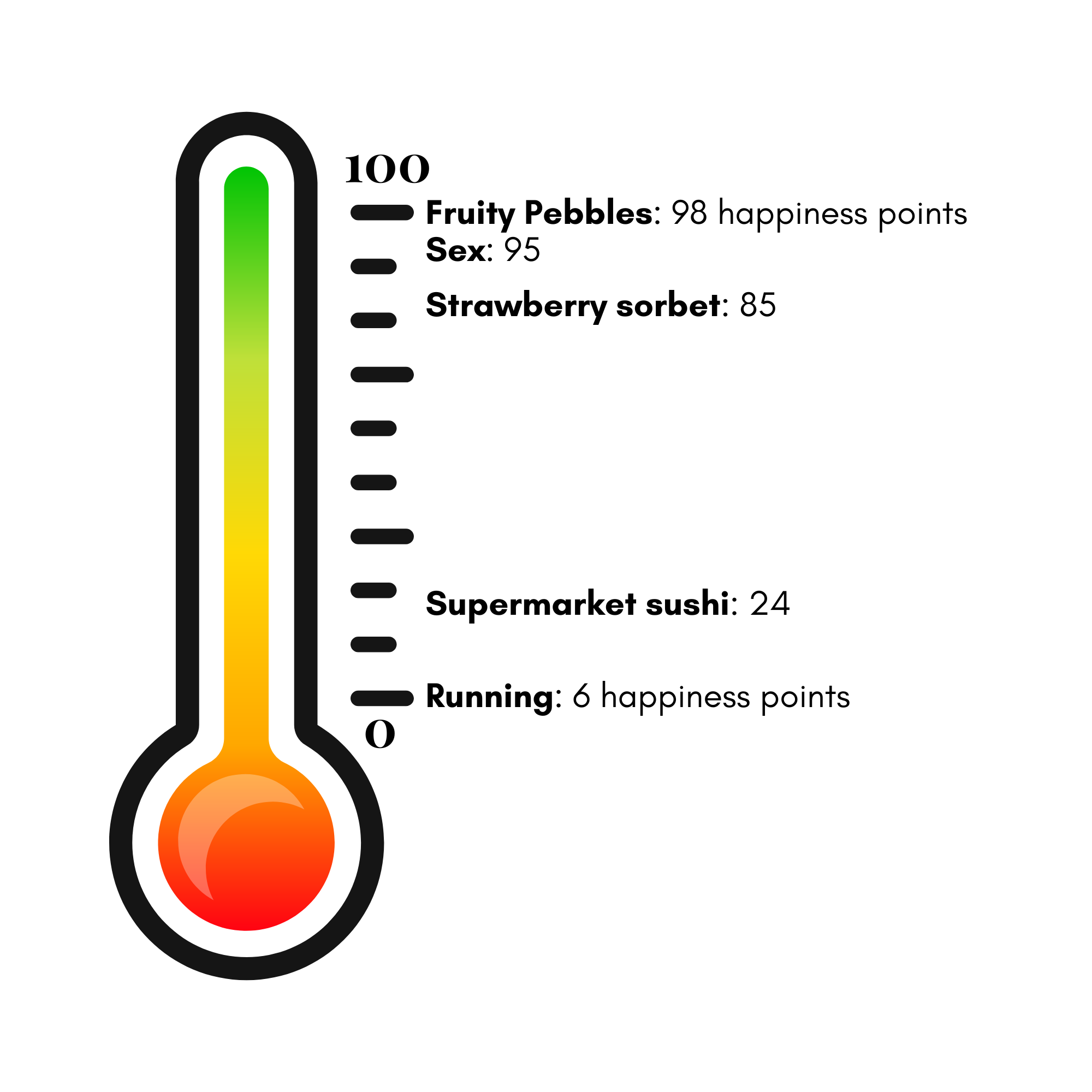
Imagine you’ve got a happiness thermometer inside you, that goes from 0 (deeply, miserably, would-rather-die unhappy) all the way to 100 (unadulterated ecstasy).
And every choice you make gives you some points on that thermometer. But everyone’s thermometer is different. I can tell you about my thermometer, but I couldn’t, without asking you, tell you about yours.
Let’s say that, on my thermometer, strawberry sorbet gives me 85 happiness points, while running only gives me 6. Sex gives me 95; Fruity Pebbles cereal gives me 98; and supermarket sushi sits at a middling 24.
That not only tells you the order of things I prefer, but how much (in numbers) I prefer one over the other:
FORMAL MATH (skip this section if you want; I promise you don’t need it)
Technically, utility isn’t actually happiness points (though that’s my favorite way of explaining it).
It’s the opposite. Utility is derived from a mathematical function that meets the following criterion:
If I prefer sorbet to sushi, then the utility function must assign a higher number to sorbet than to sushi.
In math:

At the risk of repeating myself: utility is personal. Fruity Pebbles aren’t objectively better than sex (probably), and running isn’t objectively worse than supermarket sushi. That’s just my happiness thermometer.
Which also means neither you nor I can make Aya’s decision for her. She’s got to figure out her utility function. The most important thing I can do with my clients is help them determine what they’re solving for, what makes them the most satisfied.
If you find yourself balking at that—that’s also okay. It’s a sign that your utility function is solving for something else.
In other words, if staying in a marriage feels like it should be objectively better than leaving, then we’d push into what it is that makes it better. Is it better in your happiness thermometer because it meets an important social norm, because it shows you as true to your word, because it a religious principle that’s important to you?
The more clarity anyone can get on their utility, the more clarity they can bring to the big, consequential decisions.

Photo by Jason Leung on Unsplash
Step 2: Expectation
OK, that’s utility. We could spend a lot more time with it, answering questions like how do you assign happiness points to your decisions—but this blog post is already getting long.
Let’s move on to expected.
Decisions don’t come with guaranteed outcomes. Aya was stuck because, whether or not she stayed in her marriage, the outcomes were uncertain. There were a lot of what-ifs.
Which is exactly what expectation deals with. To explain it, though, I’ve got to start—don’t run away!—with probability.
The good news is, though, if you followed the utility discussion, this one’s no different. Just like utility is a way to put numbers to happiness, probability is a way to put numbers to uncertainty.
And they both go from 0 to 100. Zero (percent, in probability’s case) means that a thing definitely won’t happen, and 100% means it definitely will.
Life, of course, unfurls in the in-between.
And broadly, we’re super comfortable with probability. We know a fair coin has a 50% chance of landing on heads. We understand what it means that penalty kicks in soccer score 70% of the time or that 80% of January gym sign-ups quit by May.
We also know that, even if a fair coin has a 50% chance of landing on heads, we can’t actually predict what any one coin flip will do.
This is an important concept: every individual coin flip? Totally random. Even though we know for absolute certainty that half the time, a fair coin lands on heads.
Follow so far?
The same is true with any uncertain event. We can’t, at all, know if the penalty kicks in tomorrow’s Manchester United match will score. Maybe all of them do. Maybe none of them do.
But we can expect (there’s that word) that 70% of penalty kicks will.
And that means you can calculate the average (aka expected) score for a penalty kick.
70% of kicks score, giving Man U a point
30% of kicks don’t score, giving Man U nothing.
On average, in expectation, every penalty kick is worth 0.7 points. Because:
(1 point × 70%) + (0 points × 30%) = 0.7 points
That is all that expectation is. It’s just a weighted average of the value of the outcomes. One outcome (the kick scores) has a value of 1 point, and happens 70% of the time; while the other outcome (the kick misses) happens 30% of the time and has a value of 0.
Expectation is a weighted average of the value of the outcomes
FORMAL MATH (skip this section if you want; I promise you don’t need it)
The expected value of a random variable is the weighted average of all its outcomes, weighted by the probability of each outcome happening. Formally:
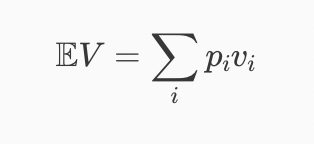
The expected value of a random event with i possible outcomes is the sum of the value of each outcome, vi, multiplied by the probability of that outcome happening, pi. It’s pretty simple with a coin flip, where heads = 1 and tails = 0:

But it also works for things with more than two outcomes. Like a dice roll, whose expected value is 3.5:

The best part about expectation is that you can use it anywhere.
For example, you could use it to make a decision about an investment:
Example: Investing in a new app
Let’s say you’re debating dropping $20,000 to create a new app. In your market research, you discover that 10% of apps go viral and make the creator half a million dollars in profit! This is awesome, and obviously the outcome you want.
But…40% of apps never make a single penny (meaning you’ve lost your $20,000 investment). And the remaining (50%) make $2000 of profit on average.
A question—how much profit you make—with an uncertain outcome is exactly where expectation shines!
Here’s how to calculate your expected profit:
10% chance you’ll make $500,000 in profit:
10% × $500,000 PROFIT = +$50,00040% chance you lose your $20,000 and have nothing to show for it:
0.4 × $20,000 LOSS = –$8,000
50% chance you’ll make $2000 in profit:
0.5 × $2000 PROFIT = +$1000
Add these all together, and you get: $50,000 – $8,000 + $1,000 = $43,000
Even though there’s a four-in-ten chance you lose your entire investment, your expected profit is over $40K! Sounds like a pretty solid investment.
Expected Utility
Alright, if you’ve made it this far, we can finally get back to Aya’s marriage. There are many ways for Aya to finally make the decision, but we went with an expected utility approach.
In other words, we calculated her happiness on average. It’s the exact same calculation as the app investment above, except instead of dollars, the outcome is happiness points.
We’ll do that next week. Next week, we’ll work through Aya’s entire decision. What’s her average happiness if she stays? If she leaves? And how does that help her decide?
And also: Bring your own big decision to next week’s post!
Like Aya, are you contemplating a breakup? Are you considering asking your boss for a raise but you’re afraid they’ll say no? Are you weighing two job offers (in this economy)? Put it in the comments below, and let’s work through it together next week.
Until then…
Consequential decisions aren’t easy. If they were, you wouldn’t struggle with them
The good news is, you don’t have to navigate them alone. Work with a discernment coach who knows how to guide you to a life you’re madly in love with again.
→ Check out my packages here. They range from 4 weeks to a year, and they take you from “what the heck do I do next?” all the way to clarity and a step-by-step plan that honors both your calling and your right to thrive. Click here to apply!
→ Want more FREE weekly content about making consequential life choices with confidence and clarity? Join my mailing list!