

DECISION COACHING
Helping thoughtful people make difficult decisions when certainty isn’t possible
All decisions are uncertain. But not all decisions are created equal.
The decisions that built your career are not the same decisions required to navigate your life. The decisions that got you stuck aren’t the decisions that’ll get you unstuck.
When identity, ambition, family, timing, money, and meaning become entangled, even highly capable executives can feel stuck.
The problem is, not all decisions can be solved with more research.
Decision coaching in NYC helps you untangle complex career and life inflection points using a rigorous, science-backed framework built for uncertainty, trade-offs, and high-stakes change.
Ready for change? Book a 1:1 consultation for executives, physicians, founders, attorneys, and senior leaders navigating major transitions.
Why Some Decisions Feel Different
You've made thousands of consequential decisions. It feels like your whole life is about making them: closing the deal, making partner, scaling the company, operating on the patient (or choosing not to!), litigating that case.
You wouldn’t have gotten to where you’re at if you didn’t make these sorts of decisions, on a daily basis!
So why does it feel like decisions that relate to you are so intractable?
I’ve got good news for you. The problem isn’t you.
It’s that the decisions executives face at personal inflection points are categorically different from the ones they make for others.
Consequential life decision are different because:
They are major
They don’t have an obvious right answer.
You can spend countless hours analyzing every option.
A wrong choice can be disastrous
BUT… The longer you wait, the more stuck you feel.
And that is what we decision scientists call a “wicked problem”—it’s no wonder that you’re feeling decision paralysis!
Feeling stuck at an inflection point? You do not need to navigate a complex decision alone — especially when the stakes touch every part of your life.

What Is a Decision Coach for Executives?
A decision coach for executives is a thinking partner who can bring the science of decision making to seemingly intractable problems. Our work together isn't therapeutic exploration, talk therapy, or directive consulting. Instead, we unpick the wicked problem, breaking it down into its component parts, handling the uncertainty around each of those parts, and building a rigorous framework that clarifies what you actually value, what you actually know, and what genuinely follows from both.
Decision coaching helps you make this decision; it also gives you a framework for future decisions, so that the next wicked problem is just not so wicked.
Decision Coaching Options for Executives

Get structured, independent clarity in 8 weeks
Self-Directed Course

Signature Program
Get the course + 12 weeks of group coaching + six 1:1 sessions

Ongoing, high-touch decision support
Private 1:1 Coaching
Not sure which option fits your situation? I can help you decide.
Decision Coaching for Your Complex Life and Career Choices
Decision coaching is built for the choices where the data runs out and judgment takes over. Specifically, this work helps you:
Separate signal from noise. Most consequential decisions have to do a lot. There’s a difference between how you take your latte in the morning, and a decision that is supposed to navigate the entangled questions of why, who, what, how, and when.
Surface the preferences that you haven’t yet articulated. What we say we want isn’t always what we actually want. In decision science speak: revealed preferences diverge sharply from stated ones. We figure out which is which
Broaden and stress-test the option set. The choices you're weighing may not be the choices actually available to you. We fill in that choice set until it accurately reflects your current choices.
Quantify the seemingly unquantifiable. Decision science offers formal methods for comparing across incommensurable values—meaning vs. money, identity vs. flexibility—as well as the upside and downside uncertainty that any consequential decision has to navigate.
Build a decision you can defend to others—and to your future self. Through decision coaching, you gain a process robust enough that you can stand behind it, irrespective of how the outcomes unfold

Who Benefits from Decision Coaching for Executives
This work fits attorneys weighing partnership against in-house roles, finance professionals considering the move from operator to allocator, founders post-exit, and senior executives at the threshold of a pivot. It also fits physicians and surgeons navigating practice transitions—if you're in medicine, the decision coaching for healthcare professionals page addresses the specific dynamics of that field.
This is decision support for people whose choices carry both professional and deeply personal weight.
A Science-Backed Framework for Better Decisions
Coaching is about more than just feeling better.
It’s about knowing what to do next—and how to do it.
Our Work Is Structured and Evidence-Based
My decision coaching is built on multi-attribute utility theory, behavioral decision research, and the literature on decision-making under uncertainty.
In practice, we break the decision down to its component parts. We:
Structure the problem correctly — What are you actually deciding? What are you, importantly, not deciding?
Elicit your actual preferences, today — What is this decision supposed to accomplish, for you, today?
Map the uncertainty — What is knowable? What isn’t? How do we know the best time to act anyway?
Incorporate the stakeholders — Who gets a say in this decision? Who has veto power? How do we take them into account
Build an action plan — A decision is only as good as the action that comes after it. We don’t stop at the decision; we build the steps you need to make it a reality.
The same science that underpins medical decision-making, public policy, capital allocation, and market analysis becomes a framework that has been personalized to you and your inflection points.
In other words: it’s clarity and forward motion!
Dr. Mark has been featured in…







What Others Clients Say…




Why Work With Dr. Mark Shrime as Your Personal Development Coach
Plenty of coaches can help you manage stress. Very few will help you make the hard decisions that actually realign your What with your Why
Solving for Why Coaching is different

I am a practicing surgeon, a PhD in health policy and decision science, and a researcher with over 200 peer-reviewed publications.
Mark Shrime, MD, PhD, MPH, holds a doctorate in health policy and decision science from Harvard. As a practicing surgeon and decision scientist his academic work applies formal decision analysis to choices made under extreme uncertainty. His coaching practice brings that same rigor to executives facing the decisions that don't have right answers.
If you find yourself at an inflection, and the usual frameworks aren’t up to the task, that's a signal that the problem is more wicked than it looks—not that you're failing to solve it.
Let’s solve it together.
You don’t need someone to tell you what to do.
You need a framework that helps you decide—and a partner sharp enough to pressure-test your reasoning along the way.
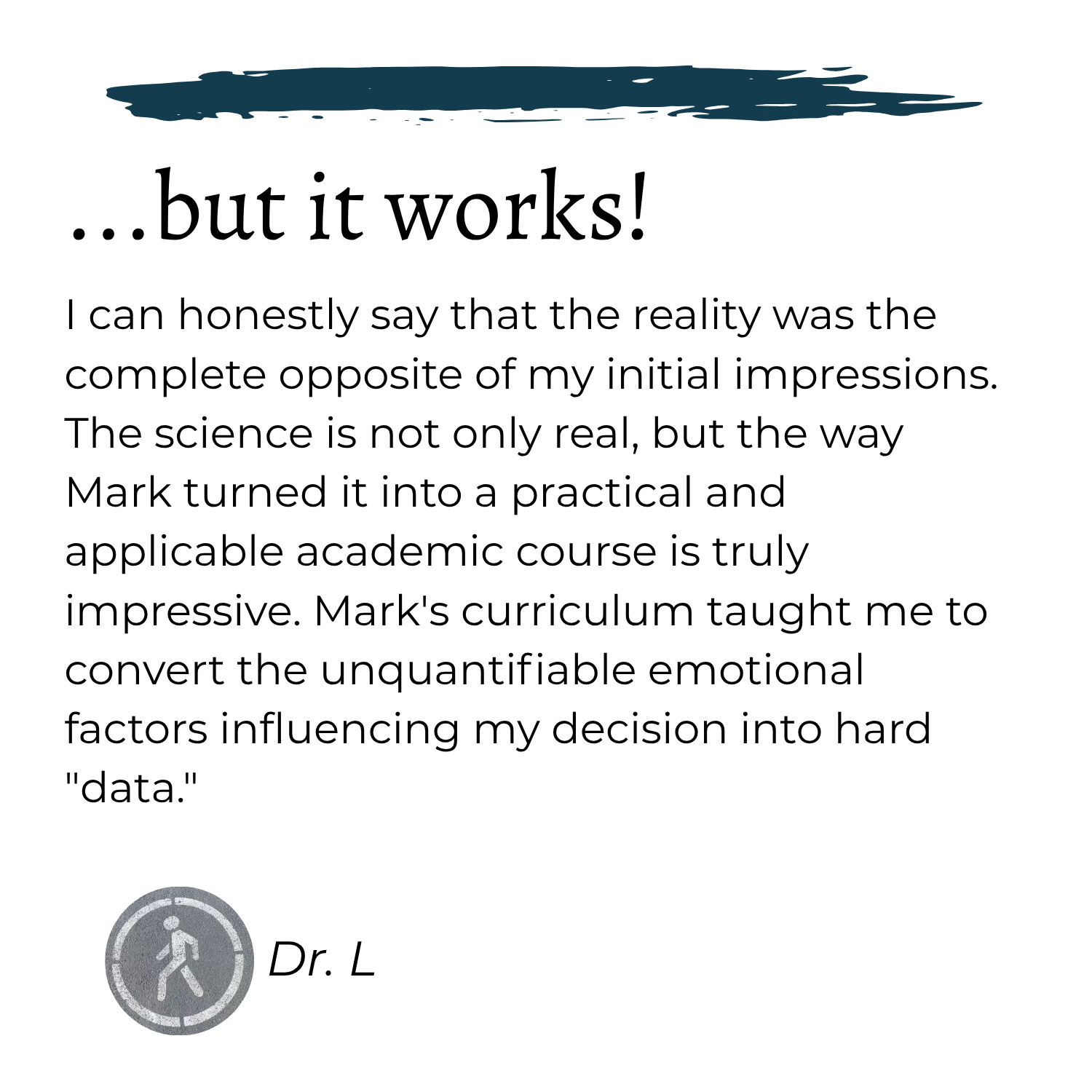
“Mark’s curriculum taught me to convert the unquantifiable emotional factors influencing my decision into hard data. I cannot recommend him highly enough!”
Frequently Asked Questions
-
Decision coaching is a structured process that helps individuals navigate complex life and career decisions.
Rather than giving generic advice, or encouraging you to just get your mindset right, or simply telling you what to do, a decision coach helps you clarify your goals, identify trade-offs, evaluate uncertainty, and build a framework for making a choice you can confidently stand behind.
-
Decision coaching is most valuable when the stakes are high and the answer is not obvious.
Common examples include career pivots, leaving a leadership role, pursuing partnership, transitioning after a business exit, relocating for an opportunity, balancing professional ambitions with family priorities, or deciding whether to pursue a major life change.
These are often decisions where multiple values, priorities, and uncertainties must be weighed simultaneously.
-
Executive coaching often focuses on leadership performance and professional development.
Consulting provides recommendations based on expertise in a particular industry or business problem.
Therapy explores emotional well-being, past experiences, and specific mental health.
Decision coaching, however, focuses specifically on helping you make a complex choice. It combines decision science, structured analysis, and personal values clarification to help you navigate uncertainty and reach a decision that aligns with what matters most.
-
My decision coaching process begins by clearly defining the decision(s) you need to make and understanding what is truly at stake.
Together, we identify your priorities, weight and arrange them in line with your goals, examine available options, assess areas of uncertainty, and explore the trade-offs involved.
Using principles from decision science, we build a decision framework tailored to your situation so that you can move forward with clarity, confidence, and a process you can apply to future decisions as well.
-
Decision coaching is for high-achieving professionals facing decisions that cannot be solved with a simple pros-and-cons list.
My clients are often executives, physicians, attorneys, founders, and senior leaders navigating complex life and career inflection points where multiple priorities collide. These decisions frequently involve difficult trade-offs between things that don't share a common measure—such as compensation and autonomy, career advancement and family priorities, or professional identity and personal fulfillment.
Decision coaching helps bring structure, clarity, and rigor to these "wicked problems" so you can make a choice you can confidently stand behind.
-
Not at all. It is designed for high-achieving individuals across all professions who find themselves navigating complex decisions, identity shifts, and career or life transitions.