
SCIENCE: Path Dependence
How a whole bunch of reasonable choices can compound into an unreasonable outcome
Burnt Out? Stuck? You're Not Broken
–
Find Your Discernment
–
Click Here To Work With Me
–
Burnt Out? Stuck? You're Not Broken – Find Your Discernment – Click Here To Work With Me –
Last week, I told you about Josh, the client who landed in a job he dreaded without ever making a wrong decision. Each choice he made in his career was a reasonable, sensible one.
And all of them led him to a life that was, at best, uninspired and, at worst, toxic.
As I mentioned last week, what happened to Josh isn’t due to some sort of character flaw. Josh fell victim to a process that explains why Blockbuster no longer exists, why the American healthcare system looks the way it does, or why our keyboards still start with a Q.
It’s called path dependence. And honestly, it’s everywhere.
Let’s start with Blockbuster.
PS. If you find yourself identifying with Josh, you’re not alone. Click the button and let’s talk:
Reasonable choices, unreasonable outcomes: a tale in three acts.
Act 1: Netflix
In September of 2000, Reed Hastings and Marc Randolph flew to Dallas to meet with John Antioco, the CEO of Blockbuster. Their pitch was simple: buy their upstart company, Netflix, for $50 million. At that point, Netflix hadn’t become the behemoth it is today; it was still mailing rental DVDs to customers in white-fringed red envelopes, and hoping those DVDs would return intact.
Hastings and Randolph offered Antioco that they’d run the online arm of the new merged business.
According to Hastings’s account, he and Randolph left the meeting “crestfallen.” Would the 60,000 Blockbuster employees hear about their offer? Were they laughing at its ridiculousness?
By 2010, Blockbuster had filed for bankruptcy. Netflix is…well, it’s Netflix. At the time of this writing, it’s worth $368 billion.
It’s tempting to call this a bad decision. But Blockbuster had nine thousand stores, billions in revenue, and a business model that printed money through late fees. They’d tweaked their model so that it just worked. It’s the path Antioco’s company was on, and there was no reason to reconsider it. Most CEOs in his chair, given those facts, would probably have done the same thing.
Act 2: Betamax
I’m old enough to remember Blockbuster. Which means I’m also old enough for the ubiquitous “Be kind, rewind” stickers on VHS tapes to be seared into my memory. Behind that late 80s palimpsest, behind those tapes, is another story.
Back in the 1970s, Sony and JVC battled for control of the home video market. Sony’s product—Betamax—was, by all technical measures, better than the VHS format that JVC offered. It produced a sharper picture, more compact tape. It had less color bleed. And it had first-mover advantage: it came out in 1974, a year before JVC released its VHS format.
But, VHS had some advantages, the most important of which was that it could record longer programs. This, it turns out, was useful for both football games and porn (no, I’m not kidding).
When they had to pick between non-interchangeable video formats, consumers initially tipped toward the football games. The death spiral for Betamax was swift: Blockbuster started stocking more VHS tapes, which meant customers bought more VHS players, which led stores to stock more VHS, which led manufacturers to produce more VHS players.
Within a decade, Betamax, even though it was a better format, was dead.
Before we go on… Are you stuck on some big decisions? Let’s talk ↓
Act 3: The American healthcare system
The American healthcare system is, by basically any criterion, the worst-designed healthcare system among OECD countries. This isn’t just my opinion either. Check out this graph plotting healthcare spending against life expectancy:
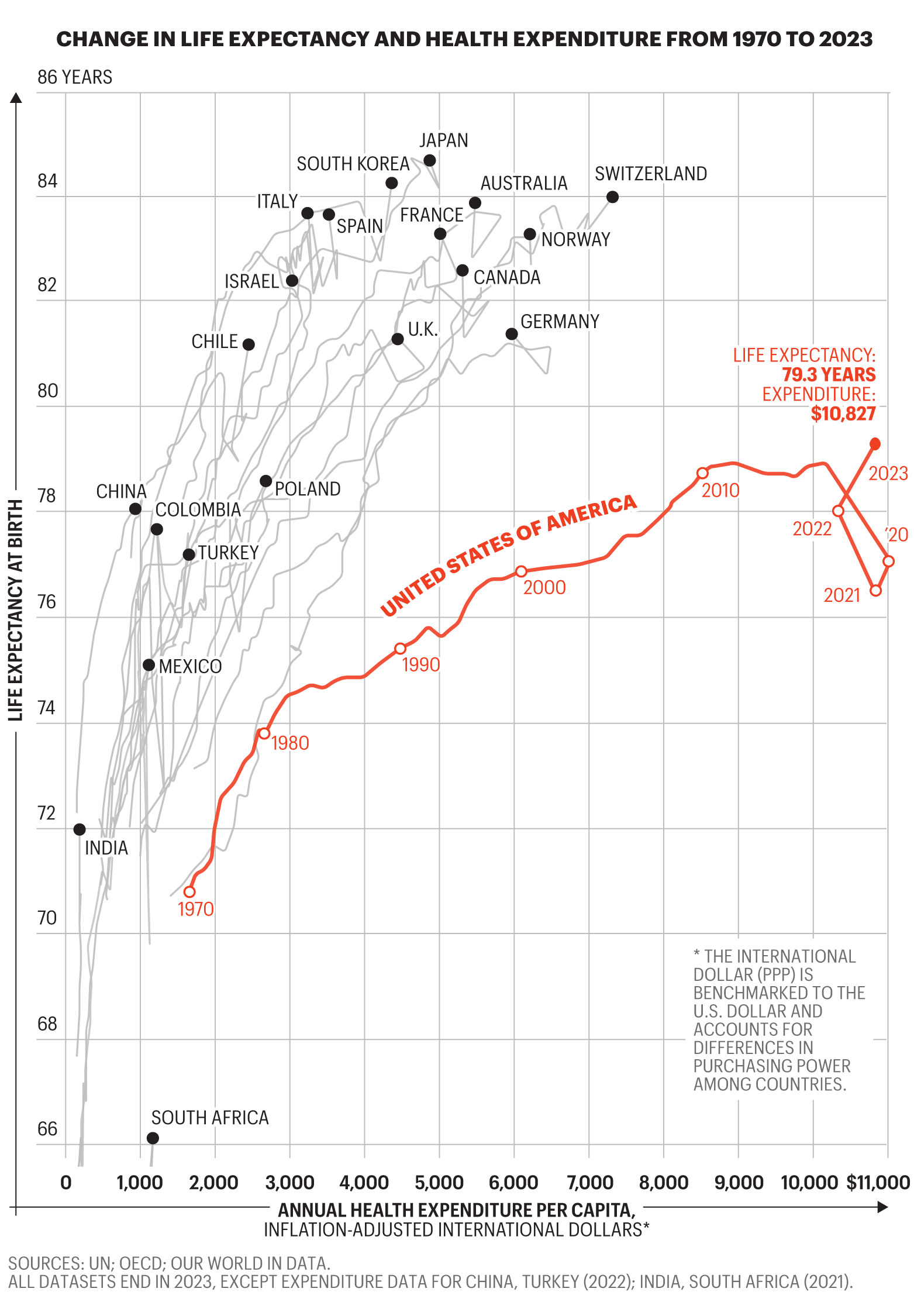
The US is an outlier: highest cost, worst outcomes. Note the dip during the early Covid pandemic. (Source: Forbes based on data from OurWorldInData.com)
It’s tempting (and very correct) to attribute all of this to the vagaries of a deeply capitalist system that prioritizes profit over health. It’s also interesting to ask why the system developed that way.
And the simple truth is that it wasn’t “developed,” so to speak. The US healthcare system didn’t arise from a careful national debate about how to finance care. It arose, instead, from a wartime workaround.
During World War II, federal wage controls prevented employers from raising salaries to attract scarce workers. So, employers began offering health insurance instead. Once one company started doing this, others followed.
Then the law caught up: the IRS determined that these benefits were tax-exempt. And by the time anyone considered whether tying your health to your employment made any real sense, hospitals, insurers, employers, and millions of workers had built their lives around the arrangement.
Eighty years later, every attempt at structural reform has to navigate the rocky shores of accumulated infrastructure. Of “well that’s just the way we do it.”
What is path dependence
Each of these examples—Betamax, Blockbuster, and your healthcare benefits—is a canonical example of path dependence.
In 1985, the economic historian Paul David published a five-page article in the American Economic Review titled “Clio and the Economics of QWERTY.” His piece asked why we still type on a keyboard layout that was designed in the 1870s.

The QWERTY keyboard layout, unchanged since the 19th century. Photo by Sam Albury on Unsplash
Developed by Christopher Latham Sholes, a newspaper printer in the late 19th century, the QWERTY layout was designed to minimize jamming that happened in mechanical typewriters when adjacent letters were struck in quick succession. (Full disclosure, not everyone agrees with this explanation.)
Over a century since Sholes introduced QWERTY, Paul David wanted to know why it persisted. Better layouts existed. The Dvorak keyboard, patented in 1936, is demonstrably more efficient, for example. Why didn’t it win?
David argued that QWERTY won not because it was better, but because “that’s how we always do it” is a powerful force that’s hard to deny. QWERTY became locked in through three reinforcing mechanisms: technical interrelatedness (typewriters and typists co-evolved; typists are used to what they’re used to), economies of scale (more QWERTY users meant cheaper QWERTY machines), and the quasi-irreversibility of investment (every typist trained on QWERTY raised the cost of switching).
The outcome was, in his memorable phrase, a result of “one damn thing follow[ing] another.”
Four years later, the economist W. Brian Arthur formalized the underlying mathematics in The Economic Journal. His paper, “Competing Technologies, Increasing Returns, and Lock-In by Historical Events,” demonstrates that when a technology gets better the more people adopt it, then early (and sometimes random) events can determine which option ultimately dominates the market. Once a critical mass tips toward one option, the system locks in. Even if a superior alternative emerges later, the cost of switching becomes too high to overcome.
In other words, the outcome of competing choices might not be determined by the inherent worth of the options themselves, but may, instead, be dependent on prior choices.
The choices aren’t made in isolation, weighing one against the other in a vacuum. They’re made dependent on the path taken to get there. History matters in a literal, mathematical sense: the order of events influences the destination.
It’s not just keyboards: Path dependence in your career choices
Companies and nations are not the only systems with increasing returns to adoption. Your life is one too.
When you take a job in a particular industry, you build skills that make you more valuable in that industry and less valuable elsewhere.
When you settle in a particular city, you grow friendships, get in with a doctor you like, learn which grocery store carries the good bread, and find the restaurant where they know you by name.
When you partner with someone, your social circles merge, your weekends take a particular flavor, your finances entwine, and the way you talk literally changes.
In isolation, each one of these things is a choice; compounded over time, each choice rules out other choices. Each choice builds a path, a path you end up deciding your next choice from.
And that’s why Josh ended up where he ended up—and why you might, too. Josh didn’t choose his dreaded job in one decision. He chose it through a hundred decisions, each of which made sense given the previous ninety-nine. By the time it became obvious that the cumulative direction was wrong, the cost of reversing felt (and honestly was) pretty enormous.
Switching paths in a path-dependent system is expensive. The inertia of past choices eventually crowds out the possibility of present ones. It leads to something I’ve previously called a crisis of imagination.
Next week, we’ll talk about what to do about path dependence in your life. In my experience, one of the more powerful antidotes is a regular, structured audit. I do one every January and every June, and next week I’ll show you how to do your own mid-year audit—while course corrections are still cheap.
Facing a consequential decision?
You don’t have to navigate it alone. Work with a decision coach who knows how to guide you to a life you’re madly in love with again.
→ Check out my packages here. They range from 4 weeks to a year, and they take you from “what the heck do I do next?” all the way to clarity and a step-by-step plan that honors both your calling and your right to thrive. Click here to apply!
→ Want more FREE weekly content about making consequential life choices with confidence and clarity? Join my mailing list!
Double-click to edit...