
PRACTICE: Making Hard Decisions With Radical Clarity
How Aya made the "Should I stay or should I go?" decision in her marriage
Burnt Out? Stuck? You're Not Broken
–
Find Your Discernment
–
Click Here To Work With Me
–
Burnt Out? Stuck? You're Not Broken – Find Your Discernment – Click Here To Work With Me –
If you’ve been here for the last few weeks, you’ve heard about Aya, her failing relationship, and the struggle she’s had with whether she should divorce her wife, Priya, to be with Daniel, her new love interest—or whether she should stick that marriage out. (If you haven’t, here’s Aya’s story, and here’s the background science behind today’s post).
Chances are, you have opinions. Aya should leave because she’s already in love with someone else and just leading Priya along. Or, counterpoint, they made a promise till death do them part, and that should outweigh any new relationship energy.
Well today, we’re going to answer Aya’s question a different way. We’re going to figure out which of her two choices will, all the uncertainties considered, make her the happiest.
PS. You don’t have to navigate your big decisions alone. Click the button to book a free call ↓
This post has five sections:
Her choices
The outcomes of her choices
The utility (aka, her happiness points) for each outcome
The probabilities of each outcome
Her decision
STEP 1: Her Choices
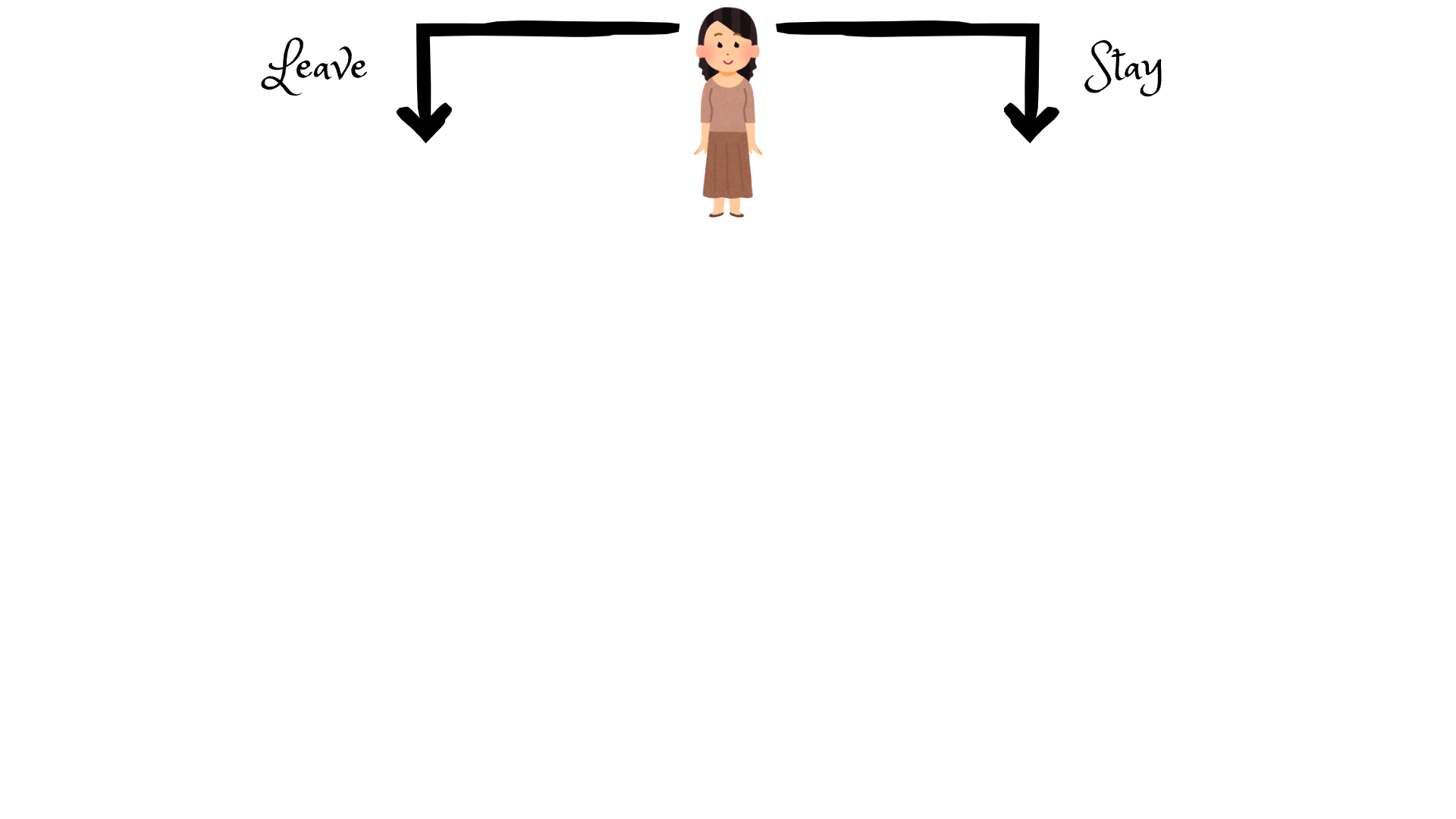
This section is the easiest. As Aya saw it, she only had two choices: Stay or Leave.
Does she, in reality, have more choices? Sure.
She and Priya could stay together but restructure their marriage agreement to allow for other relationships. She and Priya could divorce but choose to live together for the benefit of their shared cat.
An infinity of relationship structures exists outside the binary. For Aya, though, those were all deal-breakers. For her. it truly was binary:
STEP 2: The Outcomes of Her Choices
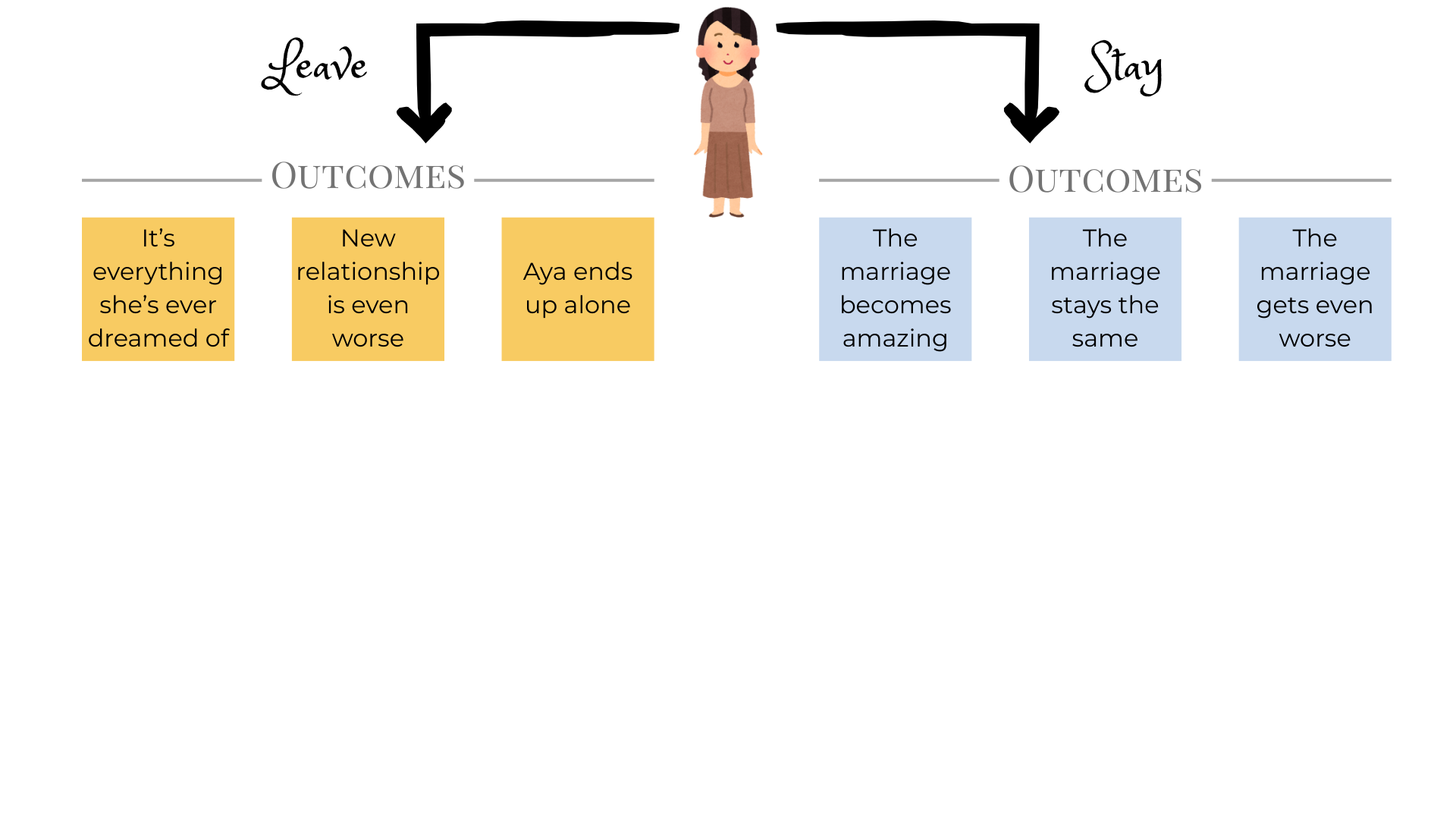
In Aya’s estimation, there were three possible outcomes of a decision to Leave and try things out with Daniel:
The relationship with Daniel is everything she’s ever dreamed of.
The relationship with Daniel devolves into an even worse relationship than the one she had with Priya, only now she’s also lost Priya too.
The relationship with Daniel doesn’t work out, and she ends up alone
When I asked her to project out the potential outcomes of staying with Priya, they were similar
The marriage could improve to everything she’s ever dreamed of in her marriage.
The marriage could stay the same as it ever was
The marriage could deteriorate so much that she’d prefer to be alone
We can use this information to build out Aya’s choice:
STEP 3: The Utility (Happiness Points) for Each Outcome
If you remember from last week, utility involves assigning happiness points to each outcome. Last week, I told you that, on a scale from 0 to 100, Fruity Pebbles gave me 98 happiness points, and supermarket sushi only gave me 24.
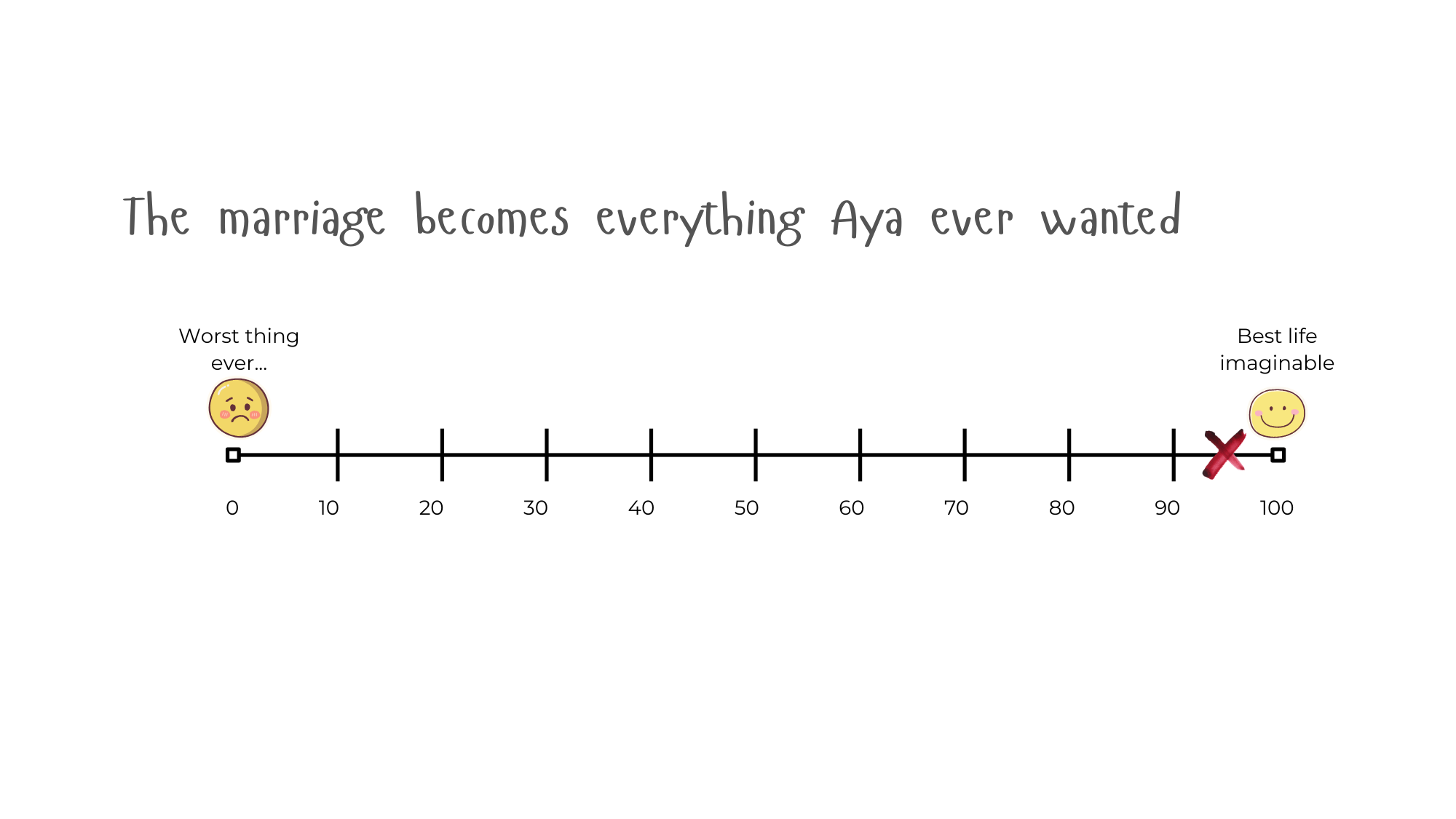
We’ve got to do the same now with Aya’s outcomes. The simplest way to do this is to draw a line, from 0 to 100, and put an X where each particular outcome is. Something like this:
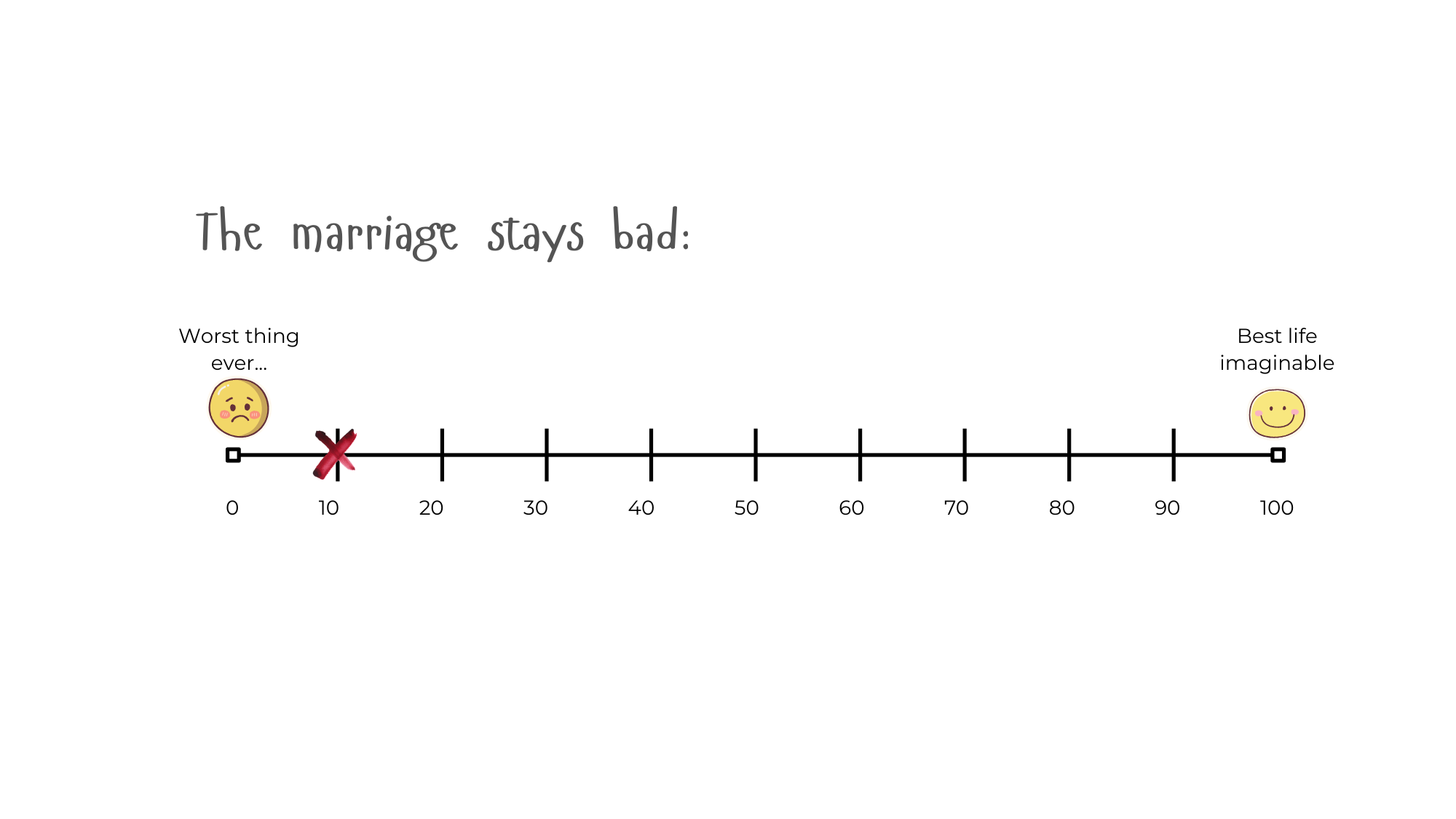
Or like this:
I’ll admit that, although this method makes happiness point assignment easy, it’s also a bit haphazard and subjective. In my work with clients, we take a much more rigorous approach to figuring out what makes them happy.
Side note: when you’re ready to work together, let’s get on a call. Book here ↓
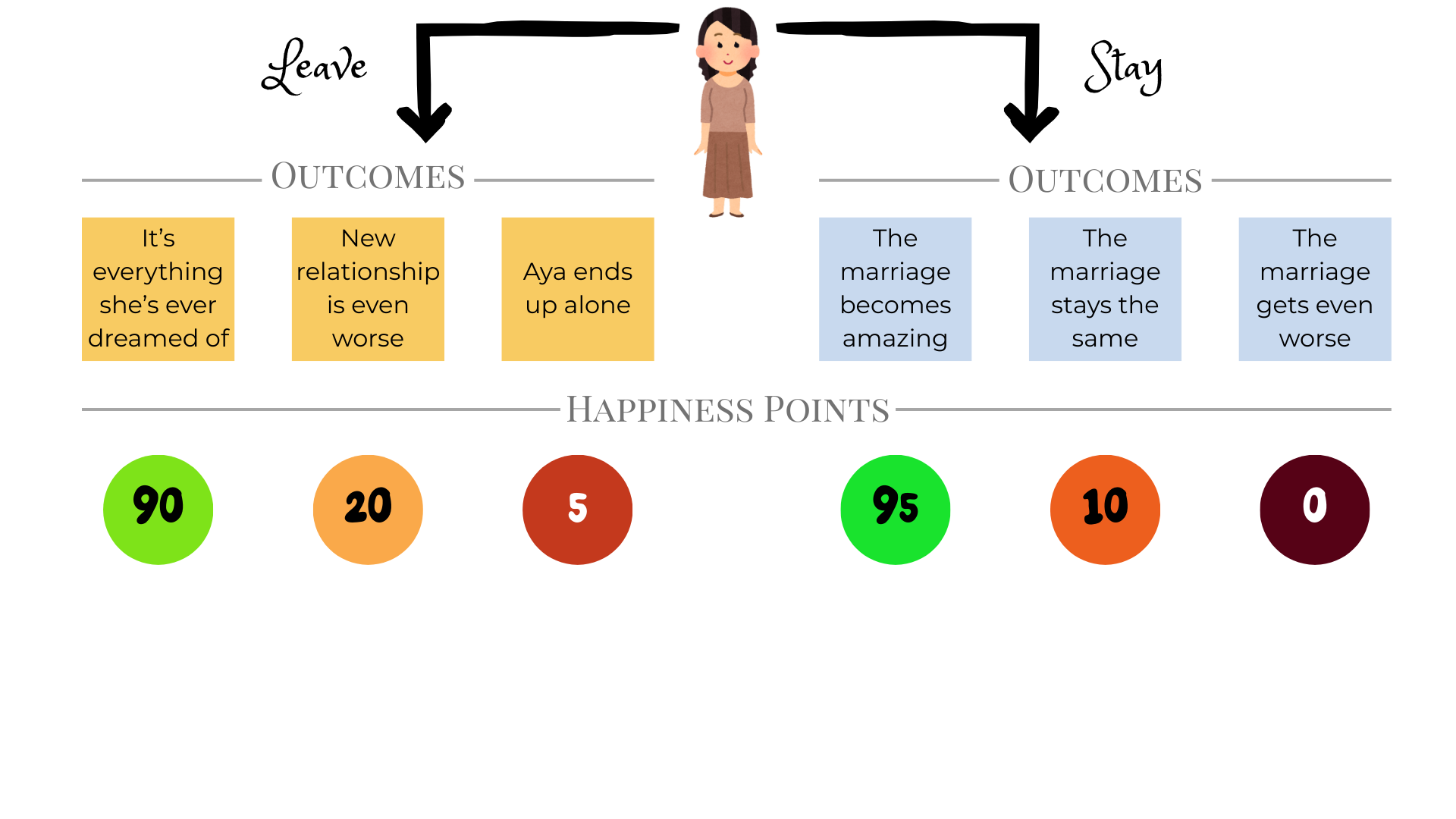
In Aya’s case, after we formally worked through her outcomes, this is where she landed:
LEAVE
The relationship with Daniel is everything she’s ever dreamed of.
90 happiness points (Aya decided not to give it a full 100 points because she would still have lost Priya, and that did hurt)
The relationship with Daniel devolves into an even worse relationship than the one she had with Priya, only now she’s also lost Priya too.
20 happiness points
The relationship with Daniel doesn’t work out, and she ends up alone
5 happiness points—this outcome was bad, but it wasn’t quite Aya’s worst case scenario. (That comes next).
STAY
The marriage could improve to everything she’s ever wanted from that relationship
95 happiness points (Deep down, she still wanted to make things work with Priya, but she would be sad to lose Daniel)
The marriage could stay the same as it ever was
10 happiness points
The marriage could deteriorate so much that she’d prefer to be alone
0 happiness points—she would have lost both Daniel and Priya
We can plug these into her decision:
STEP 4: The probabilities of each outcome
One more step before Aya can make the decision. She’s got to estimate how likely is each outcomes.
This is a hard step, because, as always, everything is uncertain! Like, truly, it could all be a coin flip!
…and that’s ok!
If you’re working through your own decision today, in tandem with Aya, you might get to this step and think, “What the heck, Mark. I have no idea how to predict if the relationship will get better or worse. I thought that was the whole point??”
If that’s you, then just make it a coin flip! It’s actually where Aya and I started too. Since there are three outcomes for each choices, then each one would have a 1/3 chance of happening. Aya’s first-pass decision tree looked like this:
LEAVE
The relationship with Daniel is everything she’s ever dreamed of: 33.3% chance
The relationship with Daniel devolves into an even worse relationship than the one she had with Priya, only now she’s also lost Priya too: 33.3% chance
The relationship with Daniel doesn’t work out, and she ends up alone: 33.3% chance
STAY
The marriage could improve to everything she’s ever wanted from that relationship: 33.3% chance
The marriage could stay the same as it ever was: 33.3% chance
The marriage could deteriorate so much that she’d prefer to be alone: 33.3% chance
But pretty quickly, Aya changed her mind. After all, she’d been experiencing life with both Priya and Daniel (and her own demons), so she had some evidence that certain outcomes might be more likely than others. In her words, “I think the chance of the relationship with Daniel working out is much higher than the chance of me being alone. I also think the chance of my marriage staying the same or getting worse is, sadly, higher than the chance of it getting better.”
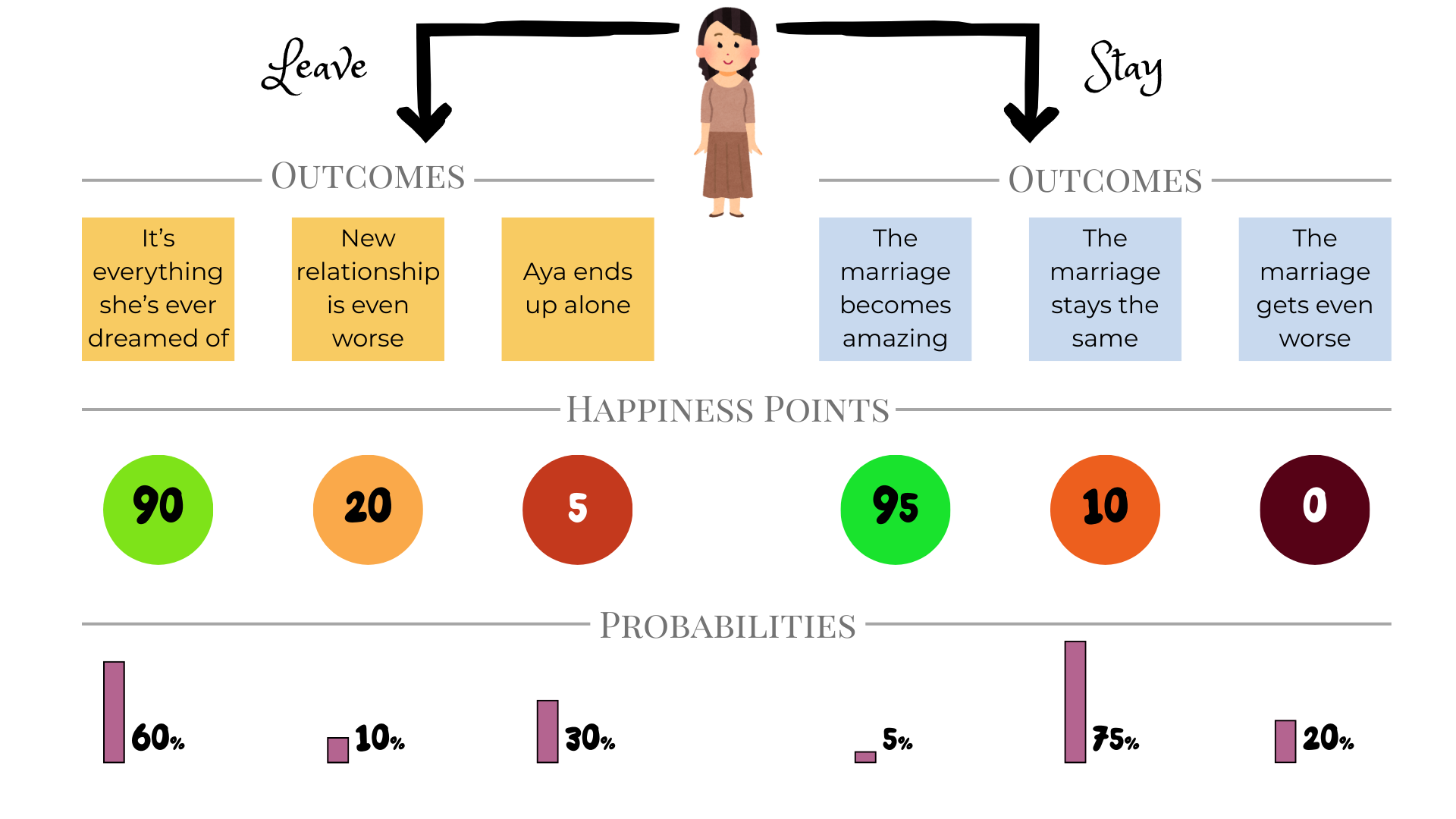
So we started tweaking, until the probabilities felt right. Here’s where we landed:
LEAVE
The relationship with Daniel is everything she’s ever dreamed of: 60% chance
The relationship with Daniel devolves into an even worse relationship than the one she had with Priya, only now she’s also lost Priya too: 10% chance
The relationship with Daniel doesn’t work out, and she ends up alone: 30% chance
STAY
The marriage could improve to everything she’s ever wanted from that relationship: 5% chance
The marriage could stay the same as it ever was: 75% chance
The marriage could deteriorate so much that she’d prefer to be alone: 20% chance
That what this looks like in Aya’s decision tree:
STEP 5: Making the decision
From here on out, it’s easy. It takes two (very simply) math-y things to get from Aya’s “what the heck do I do next?” to clarity.
We have to calculate her expected happiness. If you remember from last week, expectation is just the weighted average of the values of the outcomes.
MULTIPLY FIRST
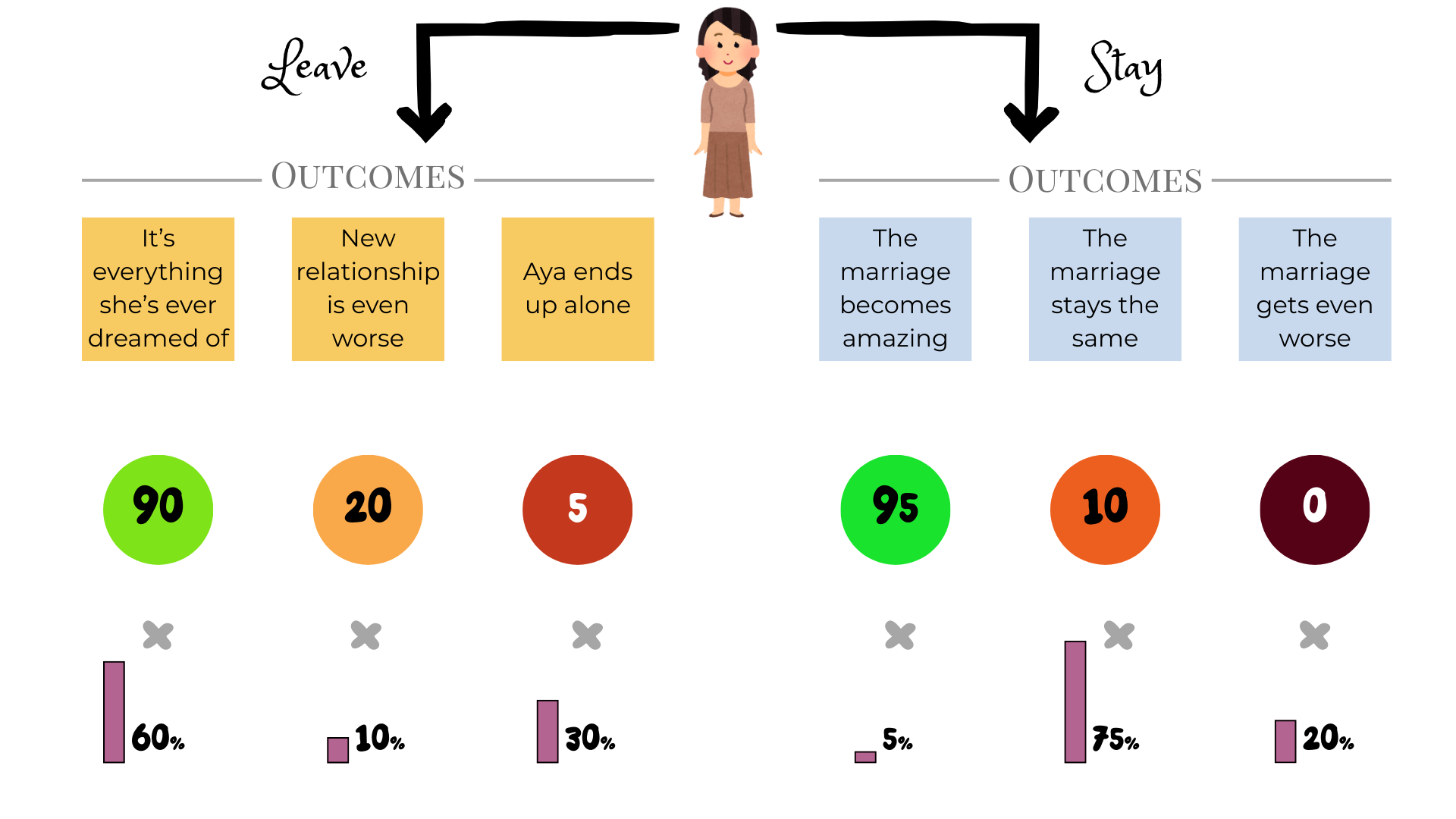
First, Aya multiplies the happiness points for each outcome by the chance that the particular outcome happens.
For example, she told us that if she leaves, there’s a 60% chance that life with Daniel is everything she’s ever wanted. She also told us that that outcome is worth 90 happiness points. Which means:
60% × 90 = 0.6 × 90 = 54
We’d do the same for each outcome:
THEN ADD
And then we add them up:
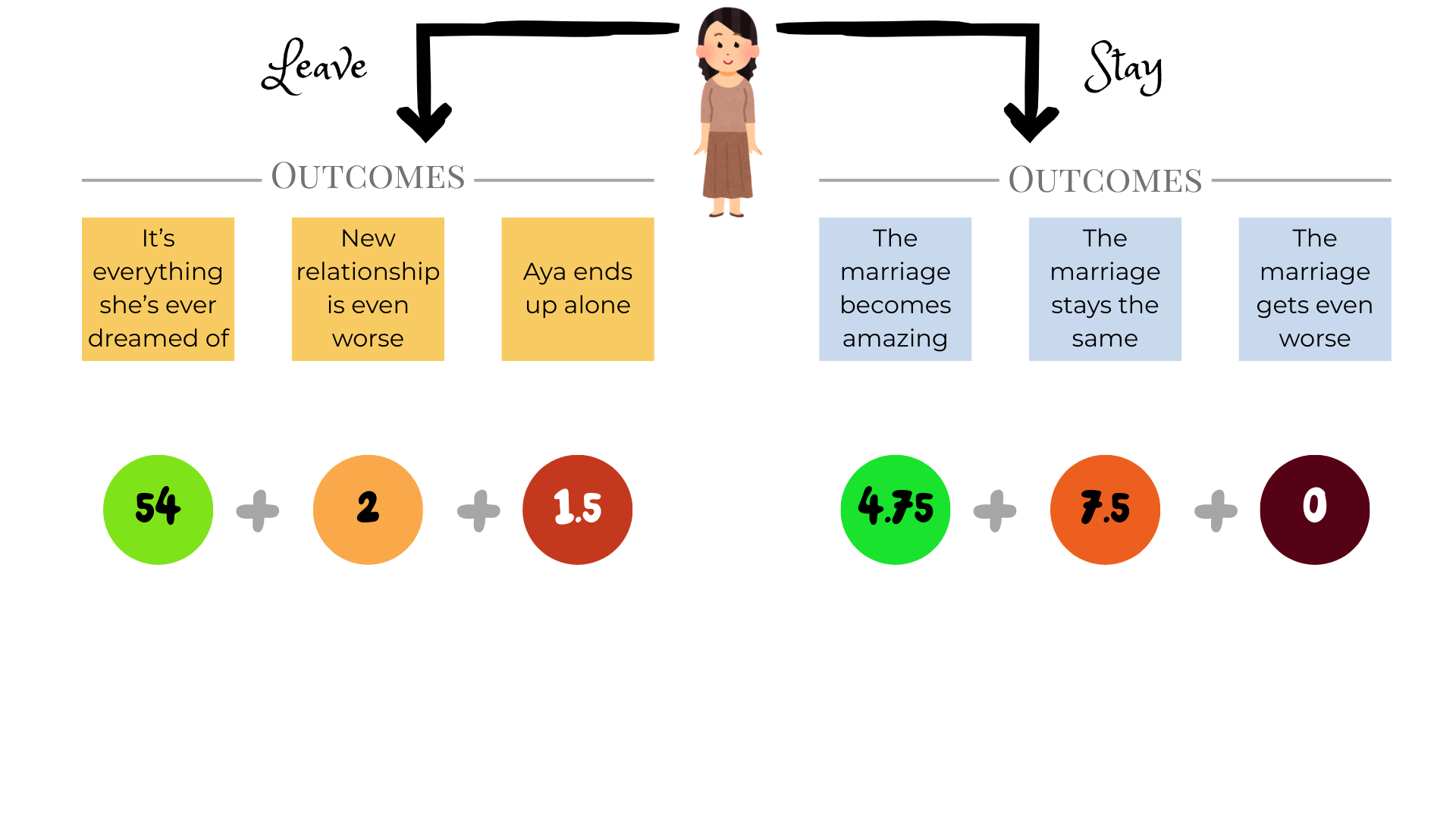
And that, my friends, gives Aya exactly how many happiness points she can expect for each choice.
In other words, even though she has no idea what’ll actually happen, Aya can say that, all things considered, her best guess is that she’ll be much happier leaving (57.5 happiness points) than staying (12.25 happiness points):
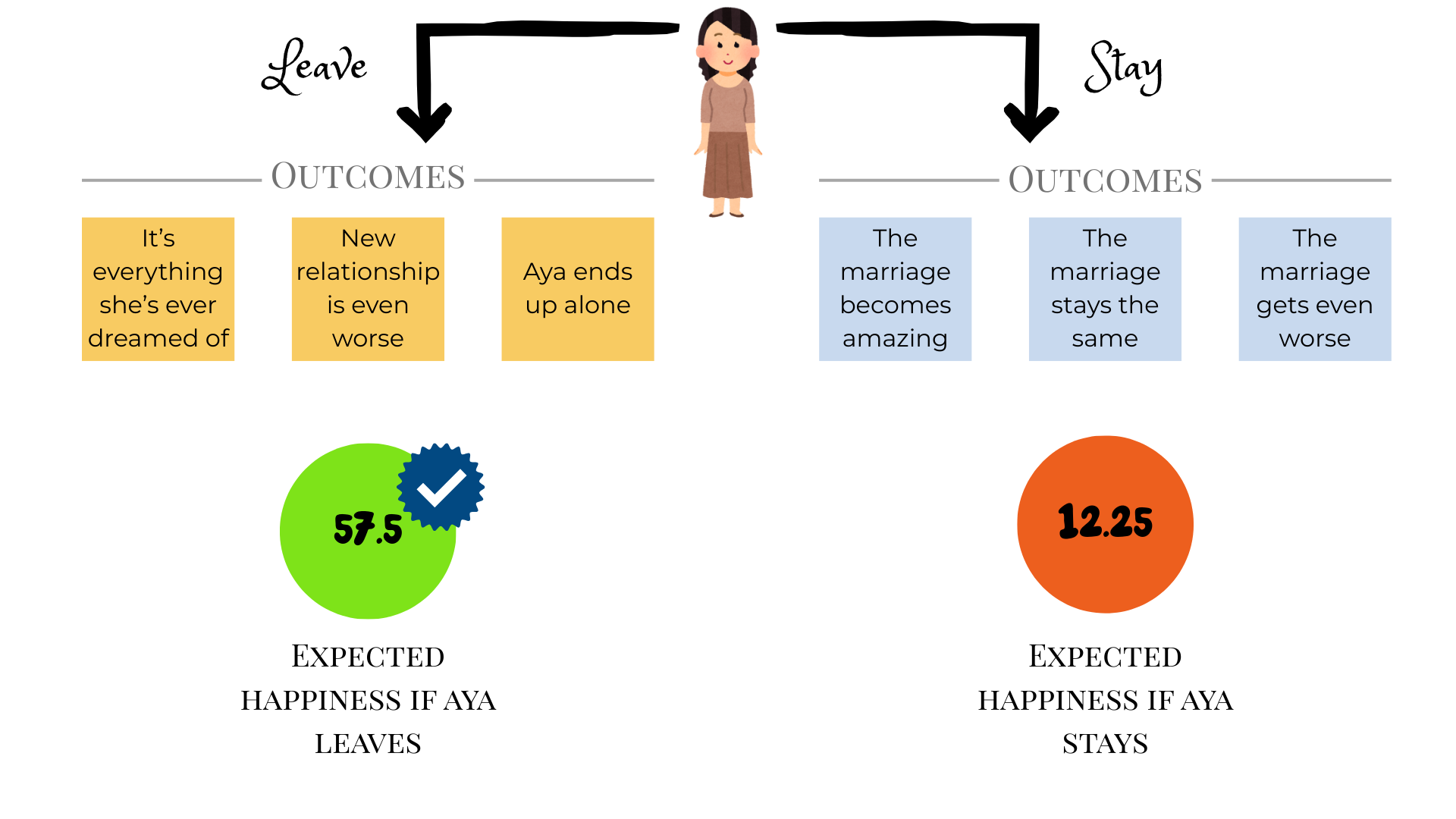
Very cool, right? Even though the future is unknown, Aya’s still able to say that leaving will give her more happiness, on average, than staying.
A final word
A decision code like this leaves some obvious questions open.
Averages feels like a heartless way to decide. What if I don’t want to use them to decide something as big as a divorce?
What if I’m wrong in how happy I’ll be?
What if I’m wrong in my probability guesses?
What if I regret things more than I thought? Is there such a thing as “regret points”?
What about deal-breakers? Like what if I just believe divorce is wrong in the first place?
Those are exactly the right questions to be asking! Decisions get murky, they get emotional, they’re still uncertain.
And that’s exactly what my clients and I spend our time untangling. Everyone’s decision is different.
It’s what makes them beautiful.
Consequential decisions aren’t easy. If they were, you wouldn’t struggle with them
The good news is, you don’t have to navigate them alone. Work with a discernment coach who knows how to guide you to a life you’re madly in love with again.
→ Check out my packages here. They range from 4 weeks to a year, and they take you from “what the heck do I do next?” all the way to clarity and a step-by-step plan that honors both your calling and your right to thrive. Click here to apply!
→ Want more FREE weekly content about making consequential life choices with confidence and clarity? Join my mailing list!
Double-click to edit...